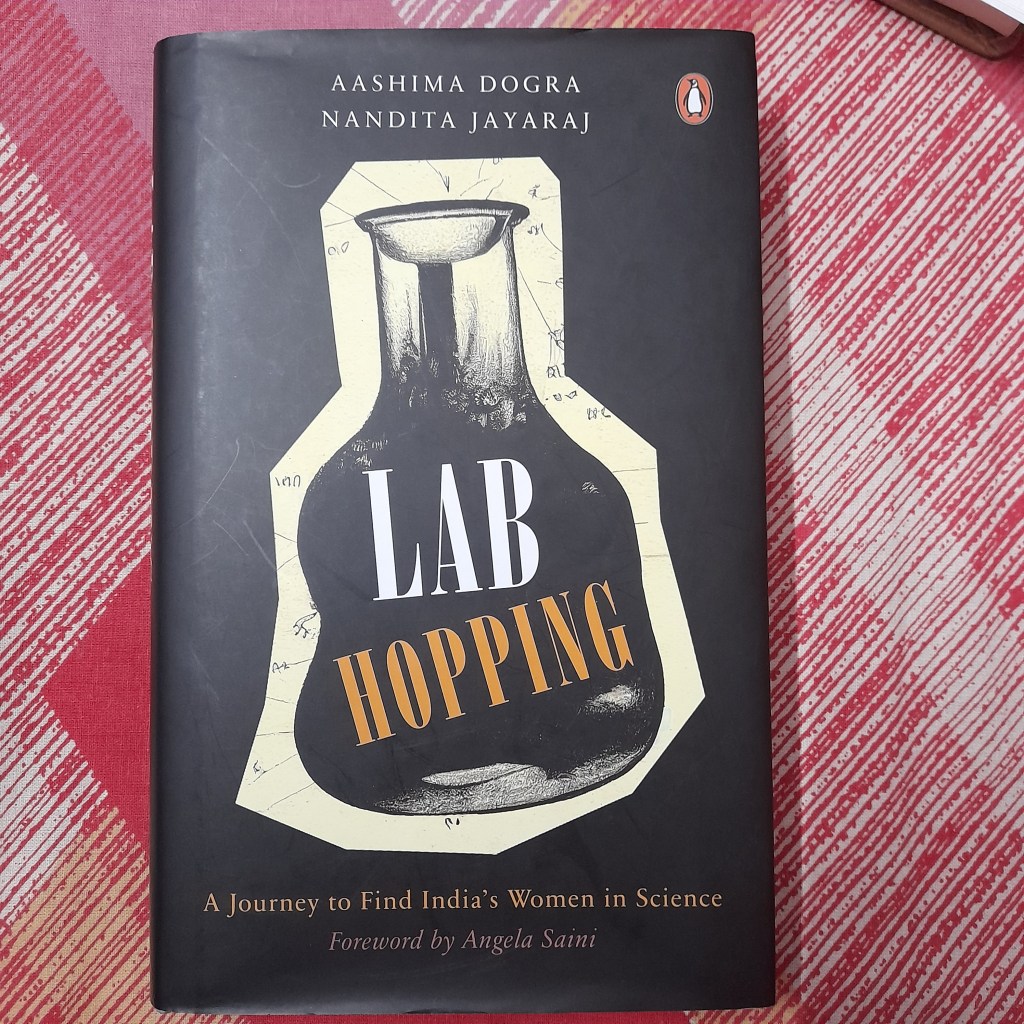
Lab Hopping: A Journey to Find India’s Women in Science by Aashima Dogra and Nandita Jayaraj is a book on the authors going Lab Hopping literally, and meeting women scientists all over India. This book is on the interviews with women scientists, their work, their science journey, the obstacles they faced, and collating them into this book. The book is divided into four parts where they tell how the idea of the book came, what they saw while they were lab hopping and went meeting women scientists, what they saw, what they noticed, and what changes could be brought.
Reading this book was illuminating for me. Despite being a science student and knowing about the gender gap, the discrimination and the sexual harassment that women face in the field of Science, it still felt that I didn’t know enough. There were stories of women who had to rebel against their families to do science. There were stories of women who had to give up on science for their family. There were stories of women who faced discrimination from the upper caste cis men, but still struggled on. There were stories of women who want to bring change in Science from within and are doing it. The women who want to do research are stuck to the post of professors, but are not promoted, and they feel stuck because they are not given opportunities to do research. These stories were given as case studies for each topic that the chapters took. I said it is illuminating because whenever Women in Science is talked about, all these are either ignored or not talked about.
Other than Women in Science, there are also mentions of caste and other sex and gender based discrimination. The intersectionality of the marginalized and the minorities are also mentioned, which are sometimes ignored again, when we talk about the inclusivity in Science. There are mentions and stories of people who are trans and from the minorities. There are also stories of women who are from minorities. The stories are of what and how they face discrimination and how they dealt with it.
The authors saw the patterns that evolved from what they saw and heard. The passion for science is what made women and people stay in Science. It is the lack of belonging and support is also what makes them leave it. Despite the laws and policies made to make women enter in Science to decrease the constant gender gap, there is still a need to bring in more changes, and to work in removing those internal biases against women and trans people and people from minorities. Science cannot be done until and unless there is diversity, and meritocracy is not a good argument against it.
The conclusion of the book is to see to the systemic change of Science and from within. Women are doing it by bringing all the data from the surveys of women in science and showing it to the people in power. The conclusion also made me hope for a better future for all the people in Science who were discriminated against. It made me hope to be in Science as a researcher. I might still not go for job as a researcher, but I might want to be there in the broad field of Science.
I was hoping to see an interview sort of discussion in the book. The interviews with each of the women scientists or who are in the path of becoming scientists, the PhD students and the postdoctoral students, would get published as it is. There would be an article based on what they got from their interviews. Despite that, I liked how the authors met people and interviewed them and gave us the struggles of people in Science (with the exception of the hetero cis upper caste men) in condensed, nuanced and clarified form. I don’t know how much stars I would give it, but I think it deserves five stars.
 Musings of an Anonymous Indian
Leave a comment